
For Partners
How florists add a premium upsell without carrying new inventory
How flower shops and gift boutiques raise average order value with a keepsake add-on that needs no stockroom, no app, and no technical setup.
7 min read
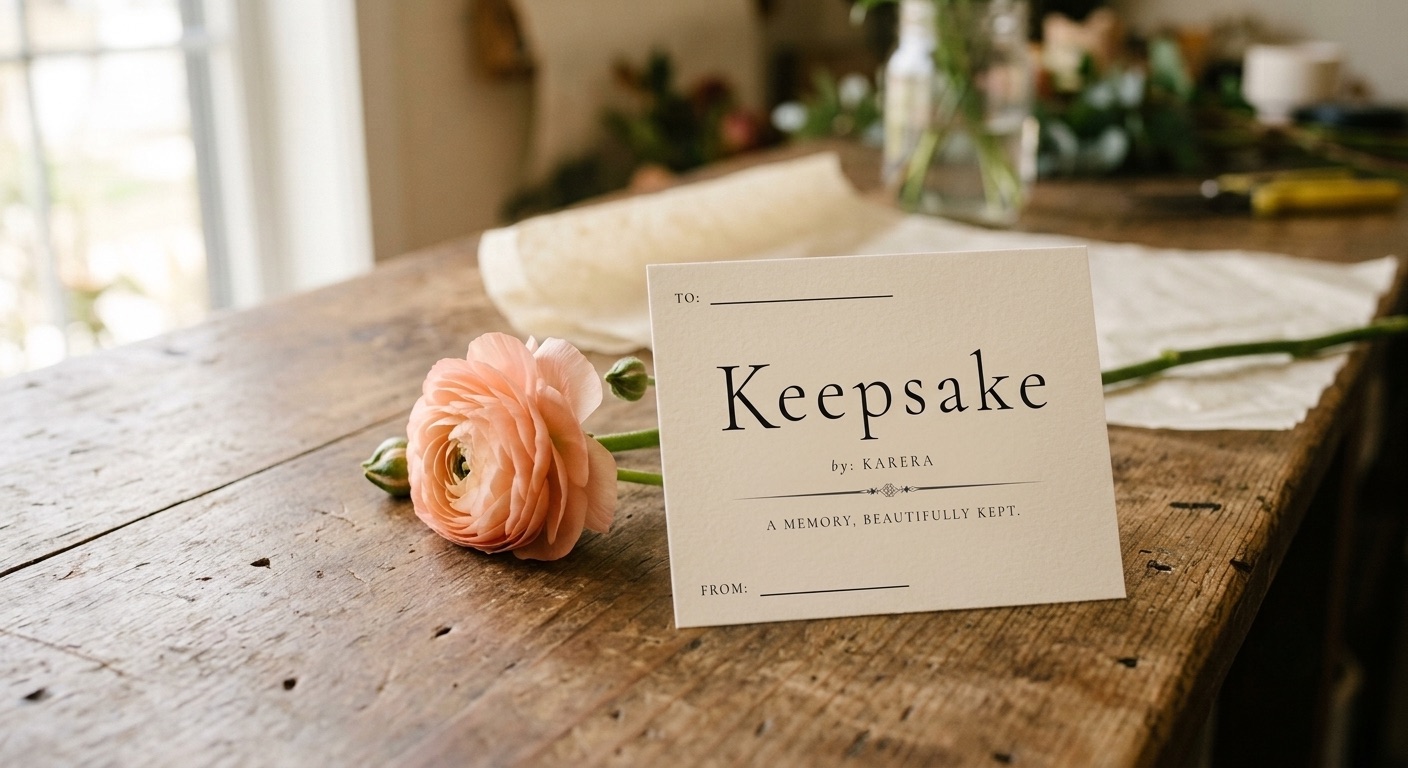
A customer walks into a flower shop and spends sixty-five dollars. They are not buying flowers. They are buying a way to say something they cannot say directly, and the flowers are the available vehicle.
They will also, almost always, hesitate at the counter — because sixty-five dollars of stems does not feel like enough for what the occasion actually is. That hesitation is the most under-served moment in the entire shop.
The upsell problem in a flower shop
Every add-on a florist can offer has the same three problems, and they compound.
- It needs stock. Chocolates, teddy bears, vases, balloons. Cash tied up in a stockroom, with a shelf life and a seasonal guess attached to it.
- It has thin margin. Resold branded goods are priced by someone else. You are a distribution channel for a confectionery company.
- It does not fit the reason they came in. Nobody standing at the counter thinking about their mother's sixtieth is helped by a bear.
So the average order sits where it sits, and the emotional intent that walked through the door goes unmonetised — which, incidentally, is also a service failure, not only a revenue one.
What an add-on has to be to work here
Four conditions. Anything that misses one of them will die on the counter within a month.
01
No inventory risk
Cards are small, flat, and do not perish. No stockroom, no seasonal buy, no write-off in February.
02
Explainable in one sentence
If it takes ninety seconds to explain at a counter with three people waiting, staff will stop offering it. The sentence has to fit in the pause while the card machine thinks.
03
No technical burden on the shop
The florist sells a card. The customer builds their own album on their own phone at home. If shop staff have to touch a screen, operate an app, or troubleshoot anything, it fails.
04
It has to match why they came in
It should deepen the gift they already chose rather than sit beside it. This is the condition that chocolates fail and this is the whole argument.
Why it converts
Not because it is cheap. Because it answers the objection the customer already has in their head.
Somebody buying flowers for a funeral, a long-distance birthday, or a milestone anniversary is worried the gift is insufficient to the moment. They are correct to worry — flowers are beautiful and they last nine days. An add-on that gives the gift a lasting archive is not an upsell in the extractive sense; it resolves the discomfort that brought them to the counter in the first place.
The best add-on is the one the customer was already looking for and could not name.
That also means it sells hardest on exactly the occasions with the highest emotional stakes and the least price sensitivity — condolences, retirements, anniversaries, long-distance family. The opposite of an impulse buy, and considerably more durable as a revenue line.
How it works operationally
01
The shop holds cards
Flat, printed, no expiry. They live in a drawer by the till, not in a stockroom.
02
Staff offer it as an add-on
One sentence at the counter, with the bouquet already chosen. It attaches to the sale that is already happening.
03
The card is activated
A small per-card activation fee is what the shop pays; the retail price and the margin above it are the shop's own.
04
The customer does the rest
They go home, follow the link, upload up to 30 photos, a short video, and a message, and choose a passcode. The shop is not involved and never sees the contents — vendors see card status only, never photos, video, or messages.
05
The recipient scans
Phone camera, passcode, album. No app. The album stays available for two years, and can be renewed after that.
The differentiation argument
There is a second reason to care about this that has nothing to do with average order value.
Flower shops compete against supermarket forecourts and same-day delivery apps on a product that is, from three metres away, indistinguishable. Independent florists cannot win that fight on price and should not try. What a supermarket cannot offer is a considered gifting experience — the thing an independent shop is actually selling and rarely gets paid for.
A keepsake add-on is one of the few things in the shop that a forecourt bucket structurally cannot replicate.
Who this is not for
Shops whose volume is overwhelmingly walk-in, sub-thirty-dollar, and transactional. If the average basket is a bunch of tulips bought on the way to dinner, there is no emotional hesitation at the counter to resolve, and the add-on will not find a moment to live in.
It works where occasions do: shops with a real proportion of funerals, anniversaries, milestone birthdays, and orders being sent rather than carried. If that describes your order book, the conversation is worth having — start here, or read the customer-side explainer first.
Questions, answered
Karera
Because some moments deserve to stay.
Shop the CollectionKeep reading
The Explainer
What Is a QR Memory Card?
A QR memory card is a printed card that opens a private album of photos, videos, and messages when scanned. Here's how it works, what it costs, and what it replaces.
Hosting
How to Run a Photo Wall at Your Company Party
A practical guide to running a QR photo wall at a corporate event: where to put the sign, how to moderate submissions, and what to send everyone afterward.
Comments
Loading comments…