
Memory Keeping
Your camera roll has 8,000 photos. Almost none of them are a gift.
We photograph more than any generation in history and give away less of it than ever. On the difference between posting a memory and handing someone one.
6 min read
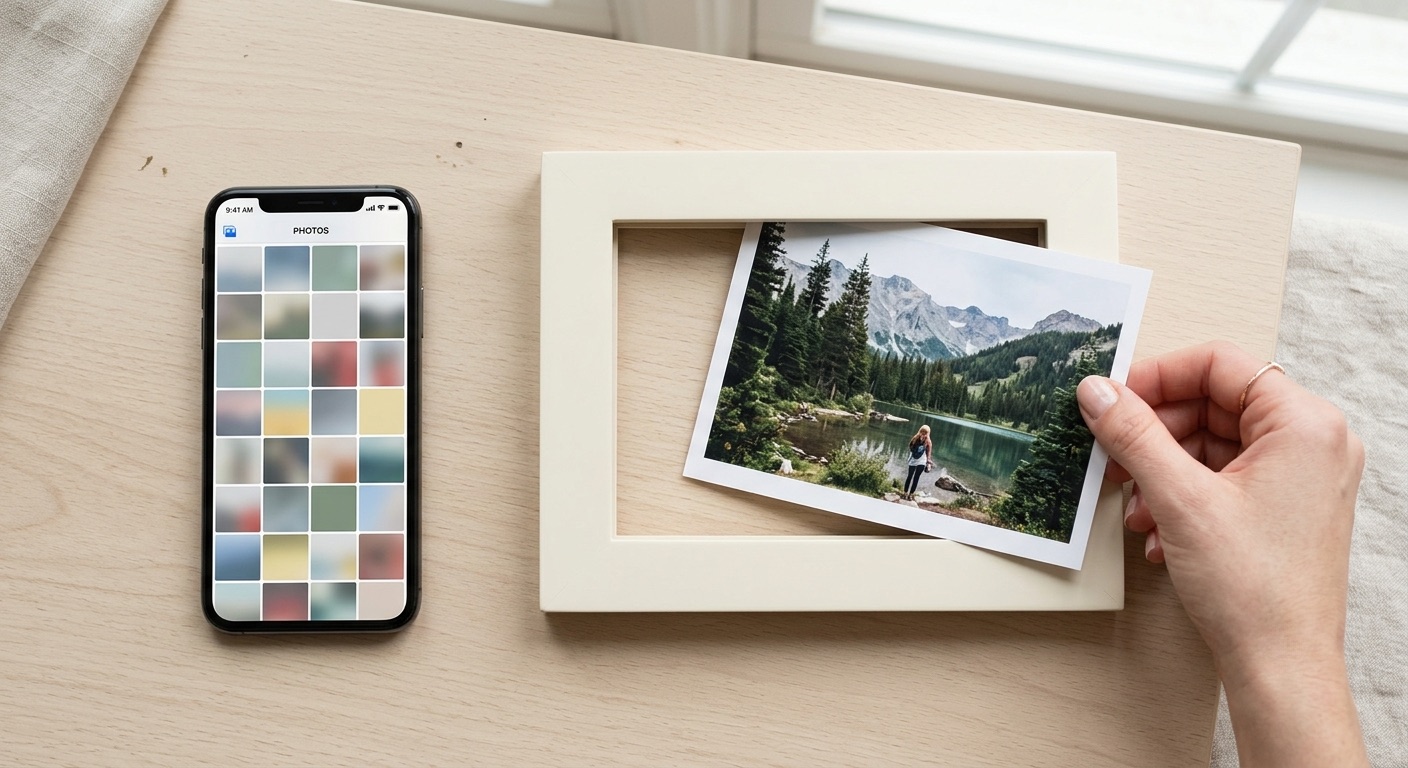
Open your phone and check the number. Most people are somewhere between four and twelve thousand photographs, which is more images than a Victorian family would have seen in a lifetime, and roughly three hundred of them are screenshots of parking spots.
We are the most photographed generation in history and we have never been worse at giving any of it away.
The archive that nobody visits
There is a particular kind of loss that camera rolls create. Not deletion — the photos are all still there, backed up in triplicate across two continents. The loss is that nobody will ever look at them.
A shoebox of prints gets opened at Christmas because it is an object and it is in the way. Twelve thousand photographs in the cloud are in nobody's way, which means they are never in anybody's hands either. Convenience quietly removed the thing that made photographs get looked at.
Nothing you own has ever been looked at less than the photos you take the most.
Posting is not giving
The obvious objection: we do share photos, constantly. Stories, posts, group chats, the family thread that has been going since 2019.
But posting a photo and giving one are different acts with different recipients. A post is addressed to everyone, which is a polite way of saying it is addressed to no one in particular. It is a broadcast. Its half-life is about nine hours, it arrives between an advert and someone's holiday, and it is measured — by the platform, and eventually by you — in reactions.
Handing someone a set of photographs assembled specifically for them, with nothing else on the page and nobody else invited, is not a smaller version of posting. It is a different thing entirely, and it is the thing that has quietly gone missing.
What to actually do with 8,000 photos
Not a cull. Everyone who has ever resolved to organise their camera roll has abandoned it around the 2018 folder, and you will too. The trick is to stop treating the archive as a problem to solve and start treating it as a source to draw from.
01
Pick a person, not a year
Search your camera roll for one person's face — every phone does this now. You will get several hundred photographs of one specific relationship, in chronological order, which is a far better organising principle than any folder system you were going to build.
02
Choose twenty, badly
Twenty is enough for a real narrative and few enough to finish in one sitting. Do not optimise. The blurry one from the kitchen is doing more emotional work than the good one from the wedding, and you know this already.
03
Put them somewhere private
The point is that this set is for one person. An album with a passcode, not a shared link that lives in a chat with nine other people in it.
04
Add the thing you would never say out loud
One paragraph. The reason you chose those twenty. This is the part people skip and it is the part that gets kept.
05
Give it a physical form
Something has to arrive. An object is what turns a file into a gift — a card, in an envelope, in a hand. Otherwise it's another link, and links do not get opened twice.
A Solo Keepsake is one way to do the last two steps at once: up to 30 photos and a short video behind a passcode, opened by scanning a printed card that arrives in a mailer box. The album stays available for two years, is renewable after that, and can be downloaded at any time. If you want the mechanics, the explainer is here.
The version of this that involves other people
There is a harder and better variant. Instead of choosing twenty photographs of someone, ask eight people to each choose three of them.
What comes back is not a better photo album; it is a portrait assembled from angles the subject has never seen. Nobody has ever received this and been unmoved by it, because it is genuinely impossible to assemble alone. A Group Keepsake collects from up to 10 contributors behind one card, which is the mechanism, but the mechanism is the easy part. The ask is the hard part.
Ask anyway. Twelve thousand photographs is a strange thing to leave nobody.
Questions, answered
Karera
Because some moments deserve to stay.
Shop the CollectionKeep reading
The Explainer
What Is a QR Memory Card?
A QR memory card is a printed card that opens a private album of photos, videos, and messages when scanned. Here's how it works, what it costs, and what it replaces.
Gift Guide
Retirement & Farewell Gifts for a Coworker
Eleven farewell gift ideas that outlast the card everyone signed in the break room — including how to collect messages from a whole team without chasing anyone.
Comments
Loading comments…